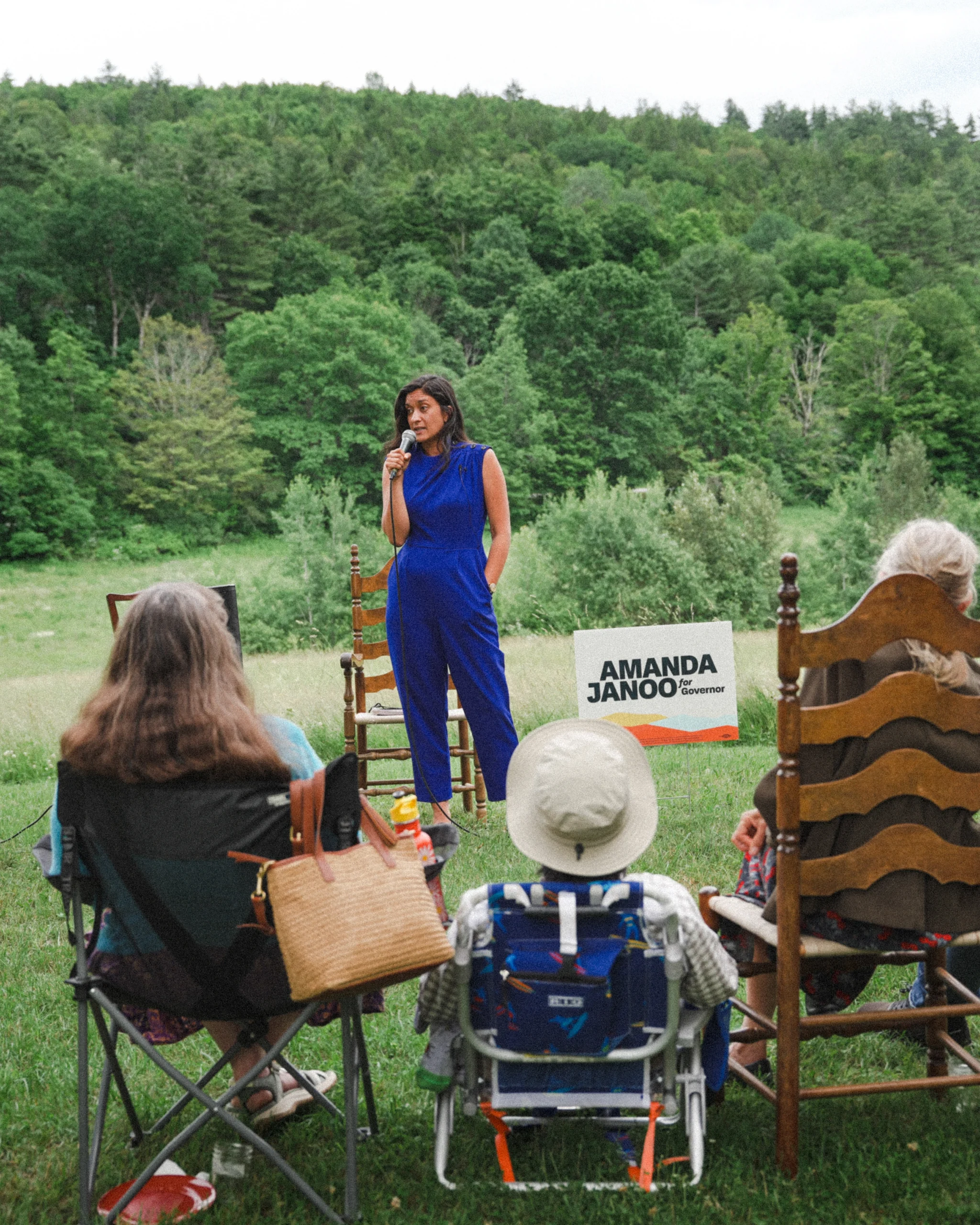
Amanda Janoo for Governor


Bernie Sanders makes rare Vermont campaign appearance, stumping with Amanda Janoo to push universal primary care
Bernie Sanders is a regular sight on the campaign trail — just not much in his home state. On Thursday, though, Vermont’s independent U.S. senator stood alongside Amanda Janoo and voiced support for the gubernatorial candidate’s proposal to offer primary healthcare to everyone in the state, free of charge.
“I think Amanda’s desire to bring, among other things, universal primary care to the state of Vermont is exactly what we need,” Sanders said in a press conference outside the Community Health Centers of Burlington clinic in Winooski. If she can do it, he added, it would be “an extraordinary achievement.”
Can Amanda Janoo Pull Off an Upset in the Race for Governor?
[Each town hall] also introduces a core tenet of Janoo’s political philosophy: Policy makers should build upon the strengths, resources and ideas that already exist within communities rather than focusing on what they lack.
Or, as Janoo often says, “Together, we have everything we need.”
It’s an oversimplified statement, as any campaign tagline is. But Janoo’s message is clearly resonating with voters. Since she announced her candidacy for governor in March, the 39-year-old economist has traversed the state to share her vision for Vermont with citizens of all stripes. Thousands have shown up — at coffee shops and senior centers, barns and auditoriums — to hear her ideas about universal primary care, bottom-up decision-making, and why the state needs to fight back against corporate and private-equity ownership of Vermont’s housing stock, which disadvantages everyday people.

Pro-Phil Scott super PAC launches ad blitz targeting Amanda Janoo
A Stronger Vermont, an independent-expenditure committee bankrolled by the Republican Governors Association, spent nearly $175,000 late last week on online and television advertisements criticizing Scott’s Democratic opponent, Amanda Janoo.
... “Super PACs and national committees are only spending on behalf of candidates if they’re worried about it, and they think their money is going to do something,” [Democratic campaign strategist Natalie] Silver said Monday.
“She has a very strong ground game. She has hundreds if not over a thousand active volunteers … and so my message to the Janoo campaign would be to keep it up, and to keep doing that work, because clearly your opponent is scared,” Silver said.

Vermont once dreamed of universal healthcare. This Democrat wants to try again — with a twist
Compared to the sweeping ambition of Vermont’s 2014 effort, or Bernie Sanders’s signature “Medicare-for-All” idea, Janoo’s proposal for single-payer has very specific limits. Under Janoo’s proposal for “universal primary and preventive care” (she typically avoids the term “single-payer”), the state government would pay for Vermonters seeing primary care providers such as doctors and nurse practitioners. This government coverage would be universal and free for patients, and insurance companies would be cut out.
However, other parts of the health system – such as hospitals, specialists, and prescription drug companies – would remain under the existing insurance system, for now.
Bernie Sanders endorses Amanda Janoo for Vermont governor
Sen. Bernie Sanders waded into his home state’s gubernatorial politics for the first time in six years when he endorsed Democratic candidate for governor Amanda Janoo Wednesday morning.
Sanders had declined to endorse Republican Gov. Phil Scott’s Democratic challengers in 2022 and 2024, and he said in a video statement Wednesday that he personally likes the five-term incumbent.
“I’ve worked with the governor on a number of issues over the years,” Sanders said. “But I believe it’s time for a change, time for new leadership, time for a kind of energy and bold ideas that we’re not seeing in Montpelier right now.”
Howard Dean: Why I'm supporting Amanda Janoo for governor
Amanda has spent her career as an economist and fiscal policy expert. She has the passion and experience Vermont needs right now, when we can no longer assume Washington will show up for us. Amanda understands how state budgets, federal dollars, and local economies actually fit together, how states like ours build real resilience, and how you get resources to our local communities that are too often left out of the conversation.
The country needs leaders with political courage. Amanda Janoo is one of those leaders: honest, serious, unafraid, and ready to do the work.
New Poll Shows Janoo With Narrow Lead Over Incumbent Gov. Scott
A new poll released on Thursday found that Democrat Amanda Janoo has a narrow lead over Vermont Gov. Phil Scott with just over five weeks to go before Election Day.
In the Green Mountain State Poll conducted by the University of New Hampshire Survey Center, 49 percent of likely general election voters backed Janoo, compared with 43 for Scott. Another 6 percent were undecided and 2 percent favored a different candidate. The survey’s margin of error is 3.4 percent.
Because the result is within the margin of error, the pollsters wrote, Janoo’s advantage “is therefore considered a statistical tie.”

America’s Most Popular GOP Governor Trails Democratic Rival: Latest Polls
“Democratic nominee for Governor Amanda Janoo has increased her support significantly since winning the Democratic primary last month and is now in a statistical tie with Republican incumbent Phil Scott. Scott’s job approval rating has been declining in recent months,” the survey’s press release said.
[...] The Vermont results line up with a broader shift toward Democrats six weeks before the midterms. An Emerson College national poll conducted September 21-22 found Democrats leading Republicans 53 percent to 42 percent on the generic congressional ballot.
5 things we’re watching in Vermont’s general election
Now seeking a sixth term, Scott is up against a challenger who could well give him the biggest run for his money yet: Amanda Janoo. The progressive Democrat rode to victory in August’s primary on a wave of voters’ discontent with the status quo and by promising bold changes like universal primary care funded by taxing the rich. Scott, meanwhile, is calling for new tax cuts and limiting state spending.
Janoo, an economist, has raised far more money at this stage of the race than any Scott challenger since 2020. And she did so after entering state politics earlier this year with virtually no name recognition and having never run for office before.

Governor hopeful Amanda Janoo visits Bellows Falls
It was standing room only Friday morning at the Flat Iron Cafe, as the curious came to see Amanda Janoo, and hear from the Democrats' latest effort to unseat longtime Republican Gov. Phil Scott.
[...] "Out with the old, in with Janoo!" said one supporter, Will Hoser of Chester, to loud applause. Scott has enjoyed tremendous support and popularity until recently, with polls showing that support for a sixth term could be eroding.
Amanda Janoo wins Democratic primary for Vermont governor
At her election night party at a mixed-used art space in Burlington, Janoo told an ebullient crowd that “as an economist, I know that money is power, but as a Vermonter, I know that money is not the only kind of power. Knowledge is power, trust is power, democracy is power, and community is power. And you should never underestimate the power of a group of Vermonters who decide to do something together,” she said.
Read moreHow Amanda Janoo, a progressive political outsider, won Vermont’s Democratic primary for governor
“When we try to advocate for just maintaining, tinkering, stabilizing these existing systems, people aren’t going to be excited. They’re not going to mobilize, and they’re going to be, sort of, frustrated,” [Janoo] said in an interview Wednesday morning. “It was really about, like, how do we expand the political imagination? How do we bring people together?” she said of her campaign. “How do we make it irresistible to want to be part of a movement for justice, together?”
Read more
Progressive outsider wins Democratic nomination to challenge Vermont’s Republican governor
At a raucous watch party Tuesday night at an event space in Burlington’s South End,Janoo described her victory as an “upset” and credited “ordinary Vermonters” for comingtogether to support her.“Tonight we proved that Vermonters are tired of the status quo and ready for bold ideasand specific solutions,” she said. In a statement conceding defeat Tuesday night, Richards said she would do everythingshe could to help elect Janoo governor.“It’s time for new leadership,” Richards said.
Read moreHow Democrat Amanda Janoo Plans to Defeat America’s Most Popular Governor
But, despite Scott's popularity, Janoo told Newsweek that the political and economic landscape is a “very different situation than we were even two years ago,” noting there's a push for real engagement and desire to be a “part of something proactive and not just reactive,” which she believes will help her win at the ballot box.
Read more
Amanda Janoo seeks Vermont governorship to create ‘wellbeing economy’
It’s the philosophy behind her campaign, which is focused on finding solutions to the state’s crises by looking at what the state already has in its back pocket. Three main goals — advancing a hopeful vision, building connection and resilience and creating a culture of belonging and fun — help light Janoo’s path.
Read more
Candidate Spotlight: Economist and Strafford native Amanda Janoo has thrown her hat into the race for governor
“Coming back, one of the things that was really clear to me was that both in Vermont and nationally, so much of this trickle-down economic logic had led to extreme inequality and concentrations of power. The way that it is manifesting in Vermont is this cost-of-living crisis, including the rising cost of healthcare, as well as housing, where I believe it’s about 92 percent of Vermonters who are not even eligible for a loan for the average house price,” said Janoo.
Read more
Amanda Janoo finds solutions
Amanda Janoo, candidate for governor, is an economist and systems thinker who clearly sees the problem and proposes a viable solution: publicly fund universal primary care. [...] Divorcing primary care from private insurance will drive down insurance premiums, school spending and property taxes, all while increasing access to health care, securing the longevity of small community health centers and avoiding nonsensical school consolidation.
Read more